
Fun Preschool Pattern Worksheets for Kids
Patterns are an enjoyable way for young children to explore order, repetition, and what comes next. Preschool pattern worksheets give children simple visual sequences that they can observe, continue, and complete.
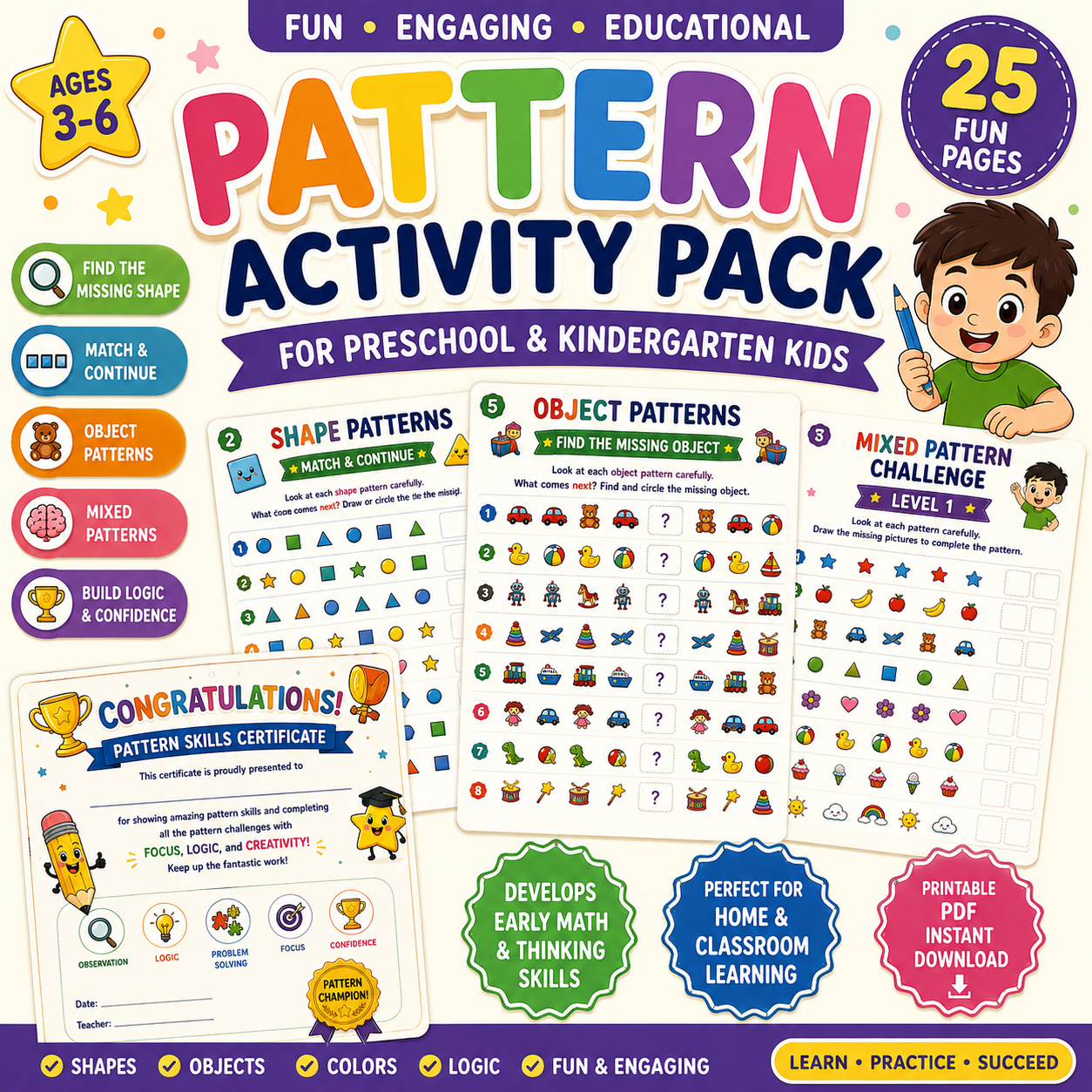
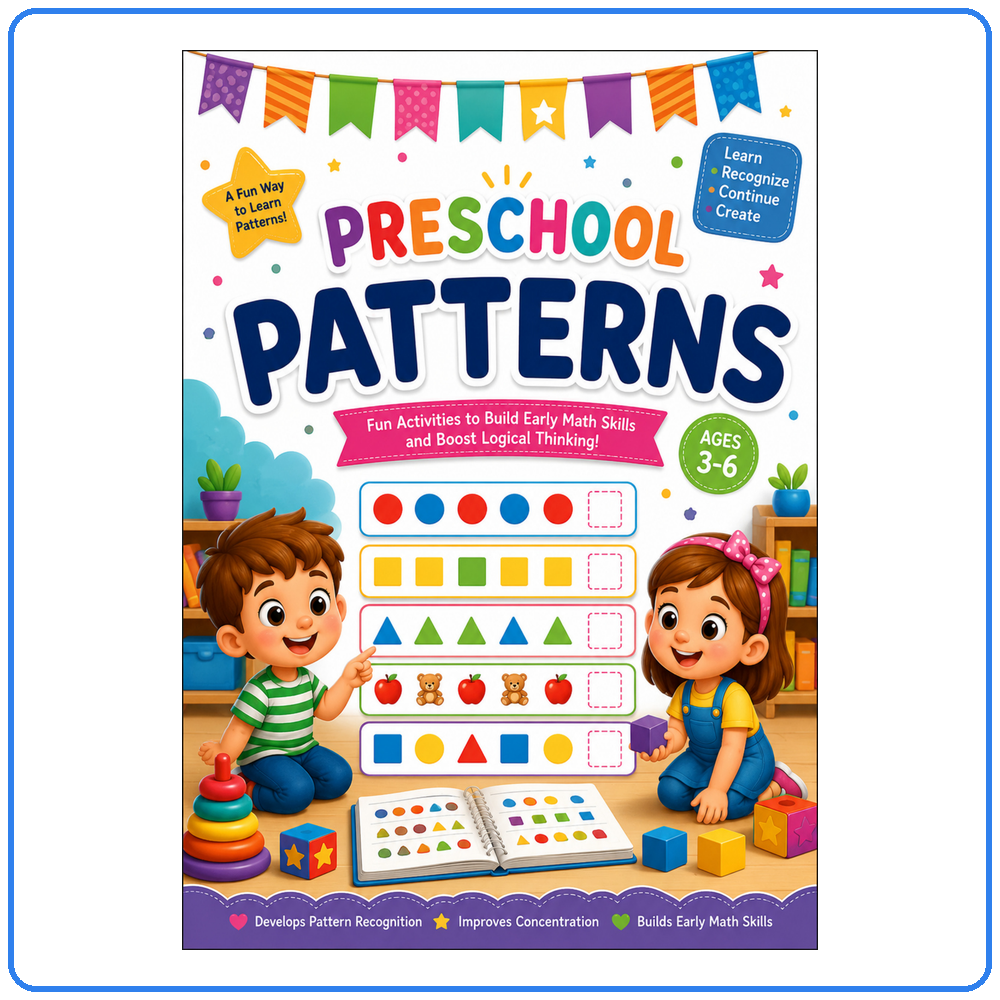
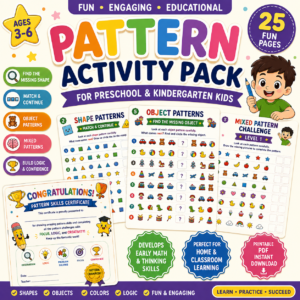
This printable activity pack introduces several pattern types, including AB, AAB, ABB, and ABC sequences. Children can also explore color patterns, shape patterns, object patterns, and missing-part activities designed to make pattern practice engaging.
What Are Preschool Pattern Worksheets?
Preschool pattern worksheets are printable learning activities that help children recognize repeating sequences and determine what should come next.
A pattern may use colors, shapes, pictures, or objects. Children study the sequence, notice what repeats, and then select or add the missing element.
For example:
🍎 🟡 🍎 🟡 __
The child identifies the repeating order and determines which item completes the sequence.
Why Are Patterns Important for Preschoolers?
Pattern activities encourage children to look for relationships between objects and understand simple sequences.
Working with patterns can support:
- Logical thinking
- Observation
- Sequencing
- Attention to detail
- Memory
- Prediction skills
- Problem-solving
- Early mathematical thinking
These skills can be useful in many areas of early learning.
What Is Included in This Pattern Activity Pack?
The pack provides a variety of pattern activities so children can practice the concept in different ways.
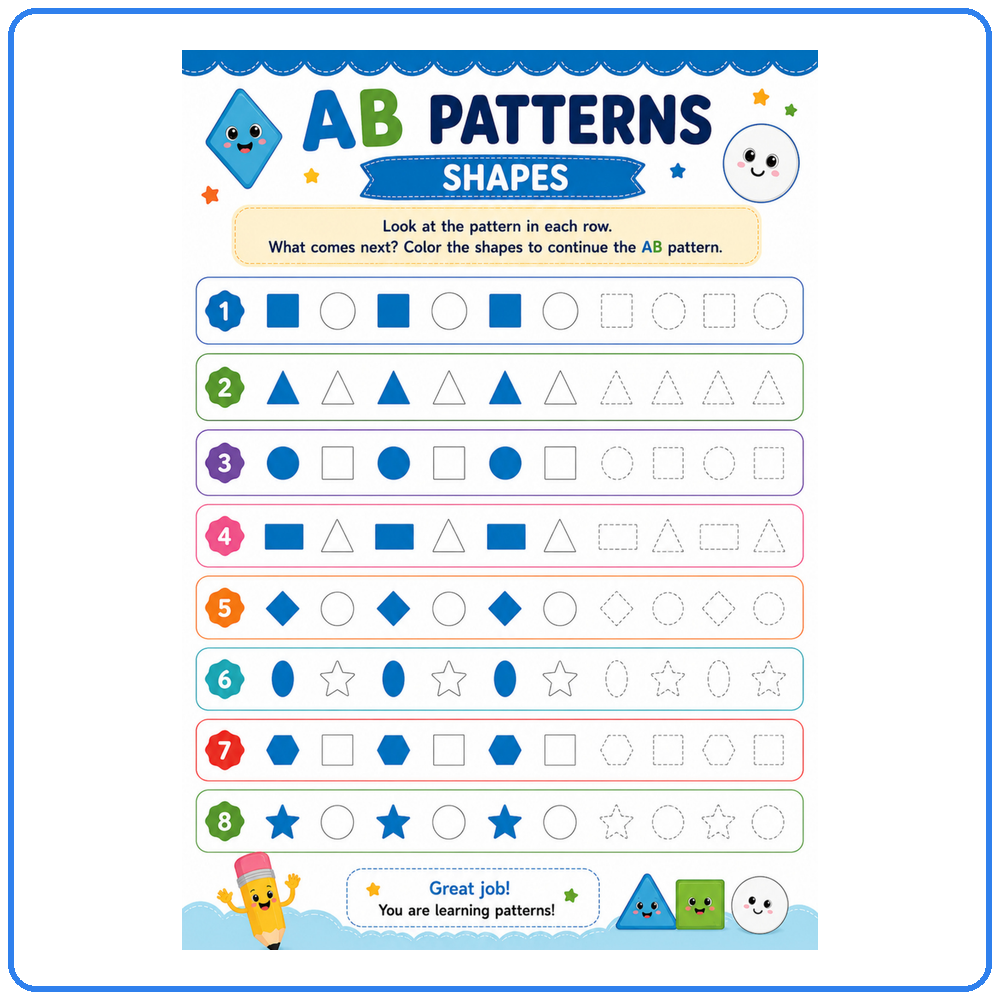
AB Patterns
AB patterns alternate between two elements.
For example:
⭐ 🔵 ⭐ 🔵 __
Children identify the repeating A-B sequence and determine the missing element.
AAB Patterns
AAB patterns use two of one element followed by one of another.
For example:
🍎 🍎 🟢 🍎 🍎 __
Children need to notice the repeated two-one structure before completing the sequence.
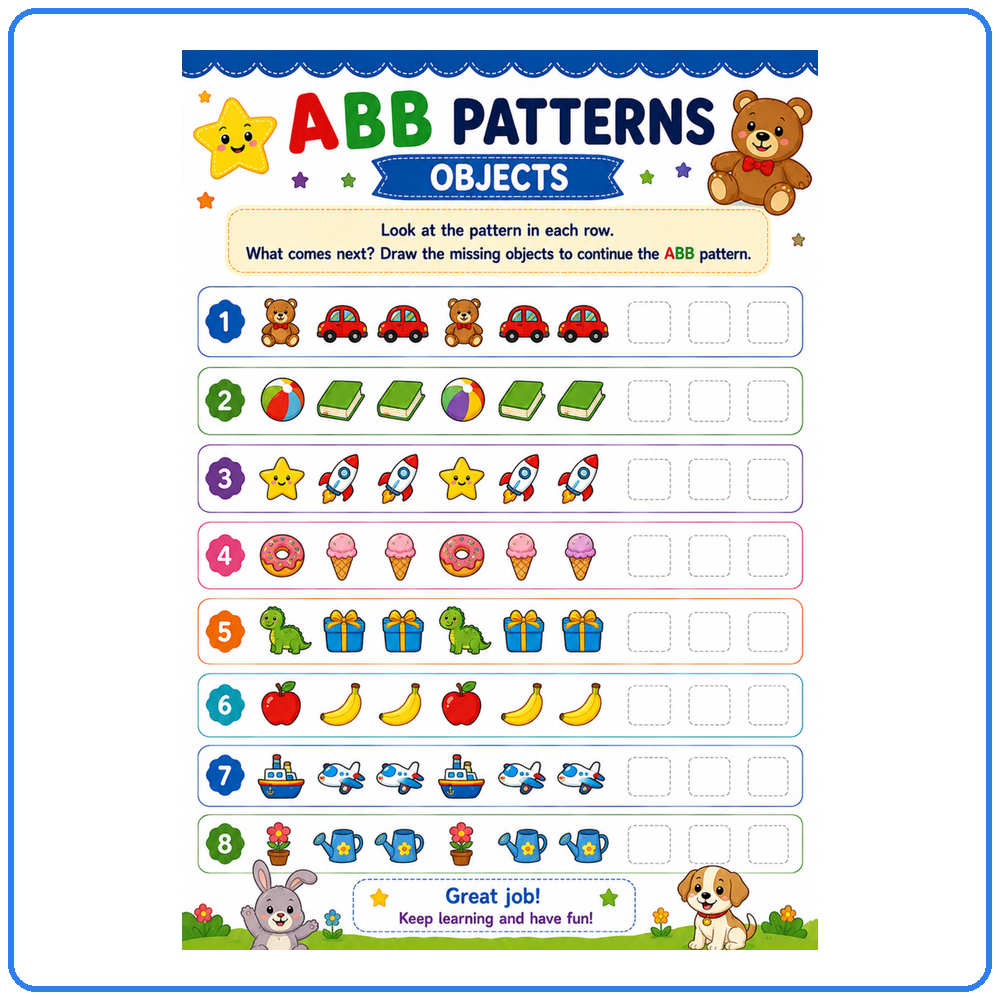
ABB Patterns
ABB patterns begin with one element followed by two of another.
For example:
🔺 🟡 🟡 🔺 🟡 🟡 __
This encourages children to pay attention to how often each element appears.
ABC Patterns
ABC patterns use three different elements in a repeating order.
For example:
🐱 ⭐ 🔵 🐱 ⭐ 🔵 __
Children observe the three-part sequence and work out which item comes next.
Color Patterns
Color-based patterns allow children to recognize repetition through visual color changes.
They can follow sequences made from different colors and identify the color needed to continue the pattern.
Shape Patterns
Shape patterns use familiar geometric forms such as circles, triangles, squares, and other simple shapes.
Children look at the order of the shapes and determine how the sequence continues.
Object Patterns
Object patterns use pictures of familiar items. Children examine the order of the objects and identify the next part of the sequence.
This can make pattern practice more relatable and engaging.
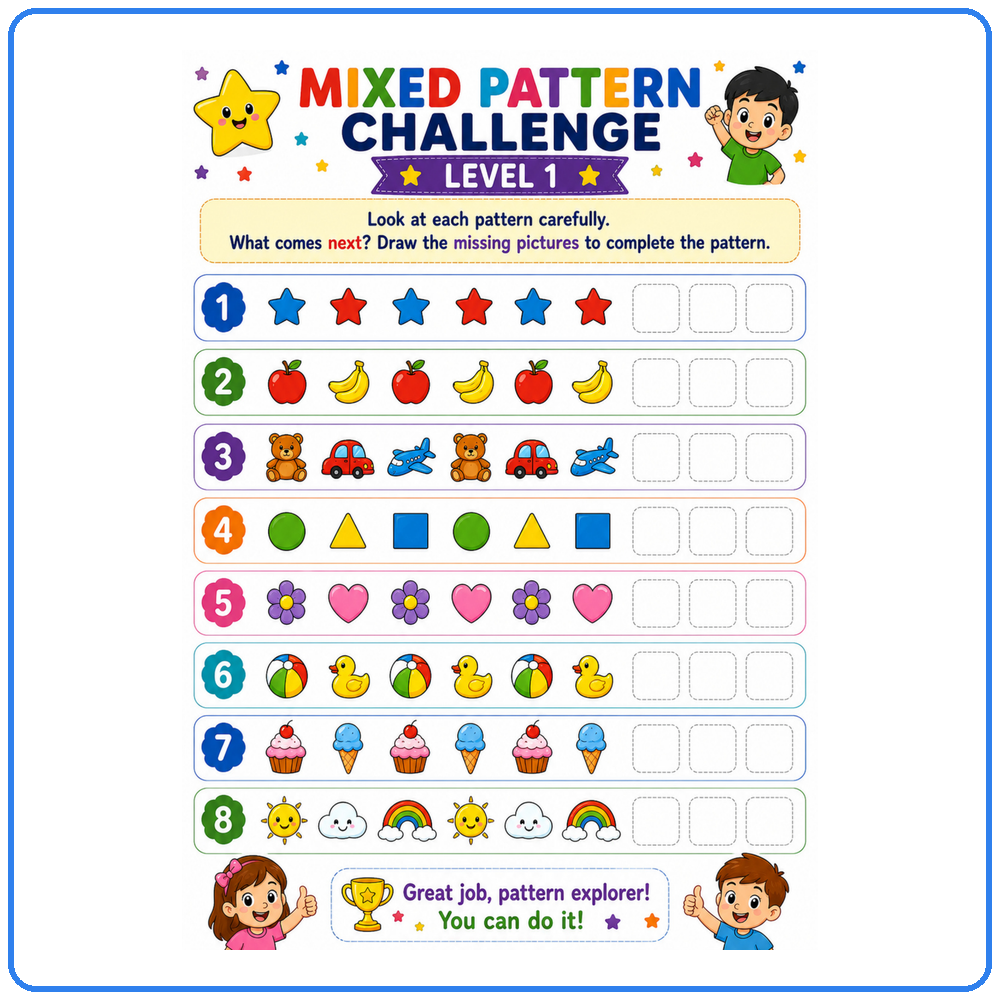
Complete-the-Pattern Activities
These activities give children a sequence with one or more missing parts.
The child studies the pattern, works out the rule, and chooses or adds the element that completes it.
These activities provide an opportunity to apply the pattern skills practiced throughout the pack.
How Pattern Activities Help Early Learning
A pattern gives children a small visual rule to discover. They need to look at what appears first, what follows, and what repeats.
For example, an AB pattern is not simply a collection of two pictures. Children need to recognize that the two elements alternate in a predictable order.
As patterns become more complex, children need to remember more of the sequence and use that information to predict what belongs next.
Skills Children Can Practice
Sequencing: Children learn to recognize the order in which items appear.
Prediction: Once a repeating rule is identified, children can anticipate the next element.
Observation: Pattern activities encourage children to examine details carefully.
Memory: Children need to remember the sequence while completing the activity.
Logical thinking: Children work out the rule behind a repeating arrangement.
Problem-solving: Missing elements require children to use what they already know about the sequence.
Who Can Use Preschool Pattern Worksheets?
These worksheets can be useful for:
- Parents
- Preschool teachers
- Homeschool educators
- Tutors
- Caregivers
- Early-learning programs
They can be used at home, in classrooms, during learning-center activities, or as additional practice.
How to Use Pattern Worksheets
Begin with patterns that are easy for the child to recognize. Once they understand the idea of repetition, introduce more complex sequences.
A simple routine is:
- Choose one activity.
- Look at the sequence together.
- Ask the child what they notice.
- Identify the repeating part.
- Ask what should come next.
- Let the child complete the pattern.
- Discuss the answer afterward.
Allow children enough time to think instead of immediately giving them the answer.
Tips for Teaching Patterns
Keep pattern practice enjoyable and interactive.
- Start with simple AB sequences.
- Use familiar pictures and shapes.
- Ask children to describe the pattern aloud.
- Encourage them to predict what comes next.
- Introduce AAB and ABB patterns gradually.
- Move to ABC patterns when they are ready.
- Praise careful thinking and effort.
- Use short practice sessions.
You can also create simple patterns with toys, blocks, or other safe household items to reinforce the concept away from the worksheet.
Pattern Practice at Home
Parents can easily connect worksheet activities with everyday play.
For example, children can arrange toys in a repeating order, make a pattern with colored blocks, or organize objects into a simple sequence.
After practicing with physical objects, a worksheet can provide a more structured challenge.
Pattern Activities in the Classroom
Teachers can introduce a pattern on a board before children begin their worksheets.
For example, a teacher can display three or four picture cards and ask students what they think should come next. Children can then complete a related worksheet independently.
Pattern activities can also work well as learning-center tasks or small-group exercises.
When Can Children Start Learning Patterns?
Many preschool-age children can begin exploring simple repeating patterns when they can recognize basic similarities and differences between familiar objects or pictures.
Starting with an easy AB sequence can make the concept accessible. As children become comfortable, adults can introduce AAB, ABB, and ABC patterns.
The pace should depend on the child’s understanding and confidence.
Printable Pattern Practice for Preschoolers
Printable worksheets provide a convenient way to give children structured pattern practice.
This pack combines several pattern styles in one resource, allowing children to move from simple repeating sequences toward activities that require them to identify missing parts.
The variety can help keep practice interesting while reinforcing the same underlying concept in different formats.
Make Pattern Learning Fun
Pattern learning does not have to feel like a formal lesson. Colorful pictures, familiar objects, and simple sequences can turn practice into an enjoyable visual challenge.
Children can look for the repeating rule, make predictions, and discover the missing piece.
Build Early Pattern-Recognition Skills
Learning to recognize patterns gives children an opportunity to practice order, repetition, prediction, and logical thinking.
With fun preschool pattern worksheets, children can explore AB, AAB, ABB, ABC, color, shape, and object patterns while developing early reasoning skills through engaging printable activities.
Frequently Asked Questions
What are preschool pattern worksheets?
Preschool pattern worksheets are printable activities that help children recognize repeating sequences, understand their order, and identify what comes next.
What types of patterns are included?
The pack includes AB, AAB, ABB, ABC, color, shape, object, and complete-the-pattern activities.
What skills do pattern worksheets develop?
They can support sequencing, observation, prediction, memory, logical thinking, attention, and early problem-solving.
What is an AB pattern?
An AB pattern repeats two elements in an alternating order, such as red-blue-red-blue.
What is an AAB pattern?
An AAB pattern repeats two of one element followed by one of another, creating a repeating three-part sequence.
What is an ABB pattern?
An ABB pattern contains one element followed by two of another element and then repeats the same structure.
What is an ABC pattern?
An ABC pattern uses three different elements in a repeating sequence, such as circle-square-triangle-circle-square-triangle.
Are these worksheets suitable for preschoolers?
Yes. The activities are designed around early pattern concepts that can be introduced according to a child’s individual learning level.
Can parents use these worksheets at home?
Yes. They can be printed and used for home learning, quiet practice, or additional preschool activities.
Can teachers use pattern worksheets in the classroom?
Yes. Teachers can use them for individual practice, small groups, learning centers, or classroom pattern lessons.
How can I make pattern learning more engaging?
Use toys, blocks, colors, or household objects to create simple sequences. Asking children to predict what comes next can turn practice into a fun challenge.
Should children start with AB patterns?
AB patterns are often a simple starting point because the repeating rule is easy to see. Children can move to more complex patterns as they become comfortable.
Does pattern practice help with early math?
Pattern activities can support early mathematical thinking by introducing ideas such as sequence, repetition, relationships, and prediction.
Reviews
There are no reviews yet.